How do you teach children the art of Brainstorming?
Brainstorming is a recognised technique for activating the creative juices, bouncing ideas off other people and creating a large bank of possible ways forward in a relatively short space of time. Advertisers and other industries recognise its usefulness but do schools make the most of it?
It made me wonder how many opportunities children have to generate lots of ideas, without the pressure of finding the right answer.
Teaching children the ‘rules’ of brainstorming helps them become more comfortable with this style of thinking; a space where children can:
- appreciate the impact of a multiplicity of ideas and realise there might be more than one answer to a problem or issue.
- understand that first thoughts are rarely the best and it can take time to modify ideas in order to find the best solution.
- Listen more closely and respect each other’s ideas, acting together as a whole group with a greater sense of ‘brain power’
There has surely got to be time in the curriculum to give children the opportunities to learn this valuable, sociable thinking skill? If nothing else it addresses Speaking and Listening objectives.
Here are some suggested ‘Ground Rules’ – worth sharing and discussing with children so the climate and culture in the class is established before you start.
- Be non-judgmental- even if you have an immediate opinion about someone’s suggestion – don’t say it out loud. You just don’t know how that first thought might turn out and it is hurtful (and unhelpful to the whole process) to shout out remarks like ‘That’s just daft’ or ‘That’s impossible’
- Encourage spontaneous and ‘freewheeling thought’ – there is nothing too left field – ever. You want children to feel that they can shout out anything that comes to mind – they need to develop the habit of just ‘blurting it out’ and not stopping to think about how it might be received. If point 1 is working, this will follow more easily.
- Aim for quantity in a brainstorming session – the quality comes later. This also reinforces the freedom of thought within a brainstorming session – which to begin with can feel very alien to children used to finding the ‘right answer’.
- Listen to others and encourage ‘piggy backing’ on what someone else has said – to expand or alter slightly.
- List every contribution – each is as valuable as another. Don’t worry about the spelling or neatness at this stage – it’s just about collecting ideas as efficiently as possible. You can have two or more ‘assistants’ in the room taking turns to write down the thoughts or maybe you could be typing directly onto the whiteboard. You don’t want any child sat there thinking ‘Why isn’t my idea being written down’. Every child must feel their ideas are valued.
To start with you will get repeated ideas – because children aren’t listening to each other as well as they might - and it does take practice. You also need to encourage clear speaking skills so everyone hears what is being said.
You can set up some short sessions for children to practise; ask them to focus on one or two ‘rules’ only to start with. E.g. ‘Let’s make sure we don’t shout out anything unkind or judgemental and listen respectfully to everyone’s ideas’
Some starter suggestions for a brainstorming session:
- Present a familiar object: light bulb, plastic plant pot, empty container like a Kinder Egg, large paper clip. Ask children to brainstorm all the different things it could be used for.
- Find an unfamiliar object and do the same: a piece from an unknown machine. (junk shops are good for this)
Over time you can make a collection of random objects for a corner of the classroom and the brainstorming challenge can change each time:
- Make a musical instrument or something that could be used as a signalling device
- Devise a new toy
- Something useful to a teacher
When children become more confident and better at the art of brainstorming, you can move them around into different groups so they get the chance to work with different ‘thinkers’ and maybe do some more extended sessions:
Start a design a technology session with some good quality brainstorming: design and create a belt with gadgets/ useful things for different job roles: plumber, astronaut, ballet dancer, teacher, rally driver etc.
Design a dog walking machine – or an ice cream cone that won’t drip.
Children can make up challenges for each other to brainstorm.
Brainstorming provides useful thinking skills - skills our children surely need?
Unless you want to brainstorm ideas to the contrary?
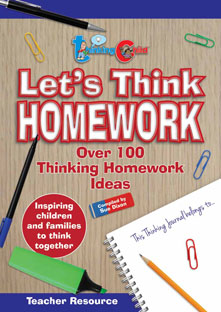
Let's Think Homework is now available as an affordable digital download